How Data-Driven Ecommerce Marketing Can Improve Sales and Customer Retention
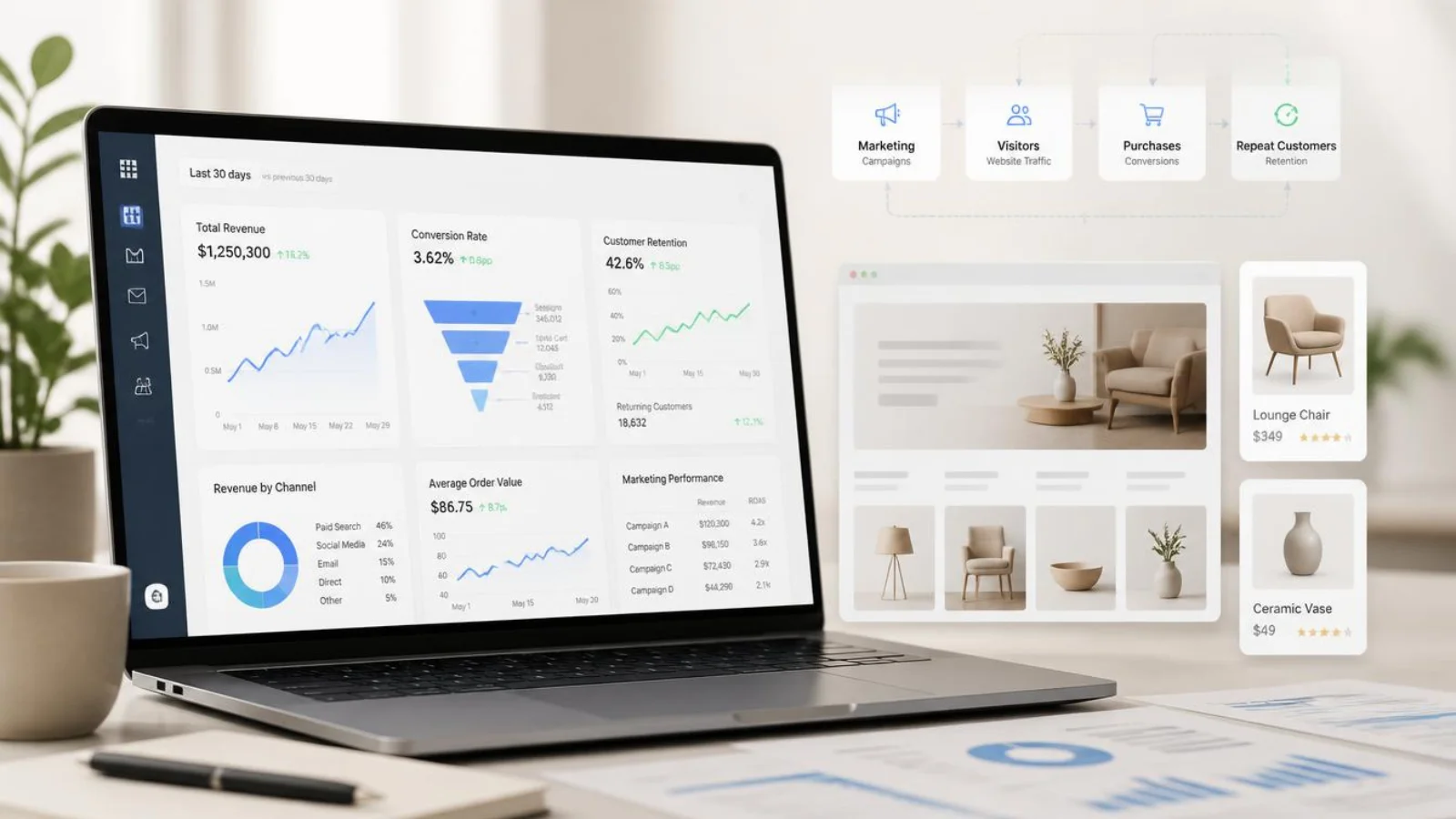
Running an ecommerce business without looking at the data is like trying to improve a store while keeping your eyes closed. You can run ads, launch products, and send emails, but it becomes much harder to know what is actually working.
Data gives ecommerce brands more than numbers. It gives context: where customers come from, what interests them, where they leave the buying journey, and what makes them return. Used well, it replaces guesswork with informed decisions.
What Does Data-Driven Ecommerce Marketing Mean?
It does not mean staring at dashboards all day. It means using real customer and business data to make marketing decisions. Useful signals include website traffic, conversion rate, average order value, customer acquisition cost, ad performance, product sales, customer behaviour, and repeat purchase rate.
The important part is connecting these numbers. A campaign may have cheap clicks and plenty of traffic, but if visitors do not buy, it may not contribute meaningful revenue. Another campaign may bring fewer visitors but significantly more purchases. Looking beyond surface-level metrics prevents investing in the wrong campaign.
Better Data Leads to Better Marketing Decisions
Data helps businesses see what deserves more attention. Rather than judging campaigns only by impressions or clicks, look at the full journey:
- Which campaign brings visitors who actually purchase?
- Which audience converts at a higher rate?
- Which products generate the most revenue?
- Which campaigns acquire customers who purchase again?
The objective is not merely traffic. It is profitable customers.
Understanding the Ecommerce Customer Journey
A customer rarely sees an ad and immediately becomes loyal. They might discover a brand on Instagram, browse products, leave, and return through Google days later. Another may visit from Facebook, join an email list, and buy after a follow-up message.
If you only see the final purchase, you miss what influenced it. Analytics helps identify where customers get stuck. Few add-to-carts after product views can signal a product-page issue. Many carts but few checkouts can point to checkout friction. One-time buyers who rarely return suggest a retention problem. Each requires a different response. See our practical guide to finding why ecommerce traffic is not converting.
Use Data to Improve Paid Advertising
Paid advertising becomes expensive when optimised for the wrong metric. Cheap clicks do not automatically make a successful campaign. Investigate what happens after the click: purchase rate, revenue, customer acquisition cost, products purchased, and whether those customers return.
Conversion rate, return on ad spend, and customer acquisition cost are useful because they reveal where to investigate. If an ad generates purchases but acquisition cost is too high, increasing budget may not be the answer. Improve the offer, product page, targeting, or checkout experience first.
Customer Retention Needs Data Too
Acquiring a new customer is only one part of growth. Purchase frequency, time between orders, customer lifetime value, and repeat purchase rate show how people behave after their first order.
You may find that customers who buy one product often buy another within months, that first-time buyers rarely return because they receive little post-purchase communication, or that a particular segment generates more long-term value. Those insights can shape email marketing, remarketing, loyalty programmes, recommendations, and customer communication.
Personalisation Becomes More Practical
Instead of sending the same message to everyone, data lets brands create experiences based on behaviour. First-time customers can receive a welcome sequence; returning customers can receive recommendations based on earlier purchases; inactive customers can receive re-engagement campaigns; and people repeatedly viewing a category can receive relevant content or offers.
Personalisation should make the experience genuinely more relevant, not simply use technology for its own sake.
The Importance of Clean Tracking
None of this works well when the underlying data is unreliable. If purchases are not tracked correctly, ad platforms optimise toward the wrong signals. Incomplete analytics makes journeys hard to understand, and unexplained differences between platforms waste time.
Treat tracking as marketing infrastructure. GA4 ecommerce measurement, Google Tag Manager, Meta Pixel, and Conversions API can collect valuable signals, but only when configured properly. Good data starts with good tracking.
Data Should Support Decisions, Not Replace Them
Data is not a strategy. A dashboard can show that conversion has fallen, but it cannot always tell you the right response. You still need to understand the product, customer, market, and business context.
Strong ecommerce teams combine both: they use data to identify patterns and opportunities, then apply experience and judgment to decide what to do next.
Turning Data Into Ecommerce Growth
A data-driven approach changes the questions a business asks. Instead of “Which ad got the most clicks?” ask “Which activity is bringing profitable customers?” Instead of “How much traffic did we get?” ask “What did that traffic do after arriving?” And instead of focusing only on first purchases, ask how to create more repeat buyers.
Ecommerce growth is about understanding visitors, improving their experience, converting more of them, and giving them a reason to return. When tracking, analytics, advertising, and customer data work together, decisions become clearer and investment becomes more confident.